

Justin Carmien will announce his candidacy for 48th Ward Alderman on May 30th at an event on the east side of Edgewater. Register for the free event here.
Carmien is a designer and author who regularly hosts civic and educational public events in the 48th ward.
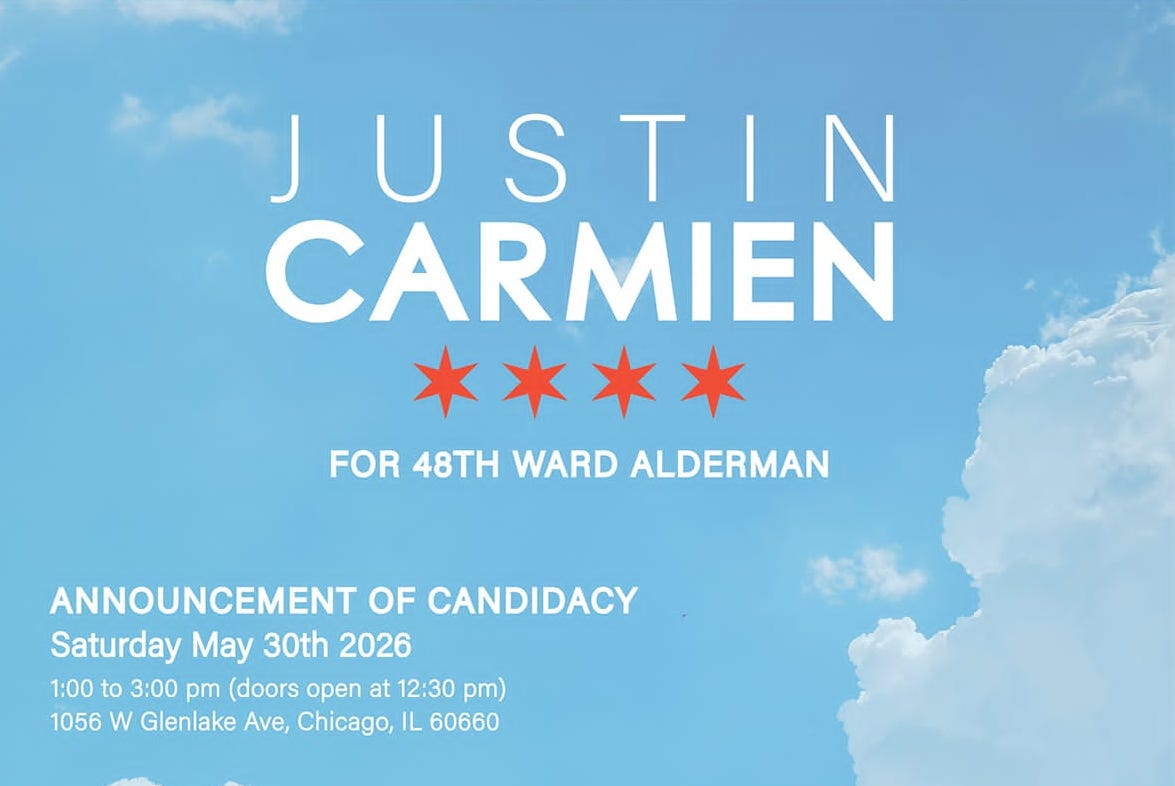
.Justin Carmien’s website/ Kick off event flyer
Carmien’s run for 48th Ward Alderman may be a natural extension of his civic engagement and career at the Government Finance Officers Association (GFOA), a Chicago-based organization that helps improve the efficiency of local governments. Or his run may be a cynical brand-building exercise. Time will certainly tell, and voters will decide, but at this moment, the Illinois Record is most concerned about what tangible bills Carmien will propose to the Chicago City Council and how he will spend his Million Dollar Aldermanic budget
Carmien may be the challenger in the race, but the incumbent Leni Manaa-Hoppenworth only won her last election by a close 52.5-47.5% margin. Justin Carmien has a serious chance of winning and Illinois Records finds it imperative to get his plans on the record.

Ballotpedia/ 2023 Chicago 48th Ward election results
Ald. Manaa-Hoppenworth has strong local connections through her Andersonville-originated company, Chicago Dance Supply, and also strong political ties as an incumbent Alderman and founder of the activist group “Indivisible Illinois,” which may be one of the most organized activist organizations in Illinois. Expect the 48th ward Aldermanic race to serve as a loud, expensive, proxy for ideological fights between the Democratic Socialists of America and Madigan Machine Blue Dog wings of the Illinois Democratic Party.
Justin is running on the platform of “progressivism 2.0,” which may be a commentary on Chicago’s history of Haymarket, Rules for Radicals, the Weather Underground, the Black Panthers, and the Indivisible Illinois style of progressive politics that relied on activism to advance their policy agenda. Carmien appears to prefer quiet to chaos and governing over revolution. Carmien pitches “progressivism 2.0” as a more grounded approach to achieving popular liberal policy goals.

Campaign Website/ Justin Carmien
Yet the Illinois Record is unfazed by rhetoric. We are not in the business of judging politicians’ promises, but in the business of putting them on record so that we can judge them in the future.
Below are Justin Carmien’s answers to our straightforward questions on what he claims he will specifically do when in power. As well as one personal question. Please share your thoughts and criticisms in the comments. And if you are an elected official or candidate, we are interested in asking you direct questions!
IR: What policy would you put forward?
Justin Carmien: I propose a Neighborhood Stability Initiative focused on housing affordability, anti-displacement protections, and long-term neighborhood investment. Chicago cannot remain a strong city if working families, seniors, and longtime residents are continually pushed toward instability by rising rents and property tax pressures.
The initiative would pursue three goals simultaneously: expanding housing supply, stabilizing existing residents, and modernizing aging housing stock. This includes targeted rent stabilization outcomes focused primarily on older housing stock so as not to discourage new development. This initiative would also address growing property tax pressures facing homeowners, seniors, and small multifamily buildings in rapidly appreciating neighborhoods.
But all of this might sound like mere platitudes without accompanying policy. Indeed, if Chicago is going to pursue rent and property tax stabilization in the near future, the City must also think strategically about helping property owners maintain and improve aging buildings. Therefore, the Neighborhood Stability Initiative would investigate incentives and financing partnerships that help offset energy modernization, accessibility, rehabilitation, and historic preservation costs in exchange for long-term neighborhood continuity.
Here is where my policy proposal becomes necessary: I would advocate for establishing an Urban Wealth Fund Commission which would work with community stakeholders and public finance experts such as the Government Finance Officers Association (GFOA) to develop long-term public wealth strategies for Chicago. Many successful global cities treat public land, infrastructure, utilities, and development rights as long-term civic assets that help support housing affordability and neighborhood investment.
Chicago already possesses enormous public resources, but too often those assets remain fragmented across agencies and disconnected from long-term planning. Rather than privatizing public resources for short-term revenue, the city should strategically leverage civic assets to generate recurring public value that can be reinvested directly into housing stability, neighborhood infrastructure, affordability initiatives, and building modernization programs. The goal is not simply monetization of public assets, but the activation of public asset revenue streams that can be used to reduce fiscal pressure on residents while strengthening neighborhood resilience and continuity.
To get an idea of how an Urban Wealth Fund looks in practice, think of the opposite of the
infamous parking meter deal. Rather than selling off revenue from public assets to private investors, we would capture revenue from those assets for public use.
IR: How would you spend the $1 million annual Menu money?
Justin Carmien: My approach to Menu funding begins with “Sustainable 48,” a ward-level master planning initiative focused on economic sustainability, affordability, environmental resilience, and mobility through thoughtful urban design and infrastructure investment.
One of my first priorities under “Sustainable 48” would be conducting an after-action review of the Edgewater Community Council’s 2010 Sustainability Plan—identifying what succeeded, what lessons can guide the next generation of environmental investments in the 48th Ward, and what goals remain unfinished.
From there, I would prioritize investments in green infrastructure, including permeable surfaces for stormwater management and other nature-based drainage systems, along with safer pedestrian mobility corridors and expanded tree canopy coverage. These projects improve daily quality of life while also reducing long-term infrastructure strain and public maintenance costs.
In April 2026, the City of Chicago updated its Green Infrastructure Strategy. This strategy provides a citywide framework for scaling these types of investments. I see an opportunity to align local Menu funding with that broader strategy while also leveraging local design and planning expertise. There is a lot of talent here in the 48th Ward. Because of the recent rezoning of the north stretch of Broadway, I’ve already been discussing green infrastructure and transit-oriented development opportunities with independent researchers at Eco Vidal Design and Open Architecture Office. The goal is to incentive both public and private investment in the 48th Ward which could then be replicated across Chicago as a model for sustainable urban design.
IR: what is your favorite “pump-up” music?
Justin Carmien: My music genre tastes are pretty diverse. What resonates with me changes depending on where I am in life. But I do remember when a former colleague told me that whenever he sees me, he thinks of the Bee Gees. I was flattered! Time after time, disco has been my go-to feel-good music. Design-wise, retro aesthetics have always resonated with me. But I’m also a very intellectual person—I like reading philosophy, studying policy, and research—
and all of that can become pretty abstract. Disco is the opposite. It puts you in a different space: present, alive, and connected to yourself in your own body.